RV/MH Heritage Foundation · Elkhart, Indiana · Preserving the legacy of two industries
More than five decades of volunteer leadership, industry service and stewardship transformed an idea formed in 1972 into today’s RV/MH Heritage Foundation, Hall of Fame, museums, archives and event campus.
In 1972, leaders from the recreational vehicle and manufactured housing industries organized what became the RV/MH Hall of Fame. Early leadership included Richard P. Robb, Clifford H. Wilmath, J. Brown Hardison, Ruth Kaseman, Curtis Fuller, Arthur Rouse, Roy Kneip, Ward Patton, Thomas Lindsay and Rex Cox. Cox served as the first president, while Robb served as the first board chairman.
The early organization was created not only to honor industry pioneers, but also to preserve records, products and memorabilia from two industries whose histories were rapidly disappearing.
Industry leaders formally organized the Hall of Fame and established a permanent program of recognition for pioneers in both the RV and manufactured housing industries.
The Foundation broadened its work toward a permanent exhibition center and repository for products, records, photographs, publications and memorabilia—laying the groundwork for the museum and library mission visitors know today.
After years of fundraising and development, the RV/MH Hall of Fame Exhibition Hall opened in downtown Elkhart, giving the organization a dedicated public home.
Darryl Searer volunteered to lead the Foundation at a time of severe financial pressure. Over the following years, operations were restructured, earned revenue expanded and debt was aggressively reduced.
The Foundation announced that its debt had been eliminated, completing a major institutional turnaround and creating capacity for future museum and campus investment.
A new 36,000-square-foot convention hall opened as part of the Northern Indiana Event Center, significantly expanding the Foundation’s ability to host industry and community events.
Hall of Fame member Darryl Searer volunteered as the Foundation’s president from 2012 through 2024, a nearly 13-year period defined by financial recovery and campus growth. When he assumed day-to-day leadership, the organization carried millions of dollars in debt. By 2019, the Foundation announced that it was debt-free.
Searer also championed earned-revenue strategies through the event center, helped lead expansion of the museum campus, and was closely associated with the campaign and development that culminated in the new East Wing Convention Center. His service is commemorated through the Darryl Searer Spirit Award, which recognizes selfless service, leadership and dedication to the Foundation and the industries it represents.
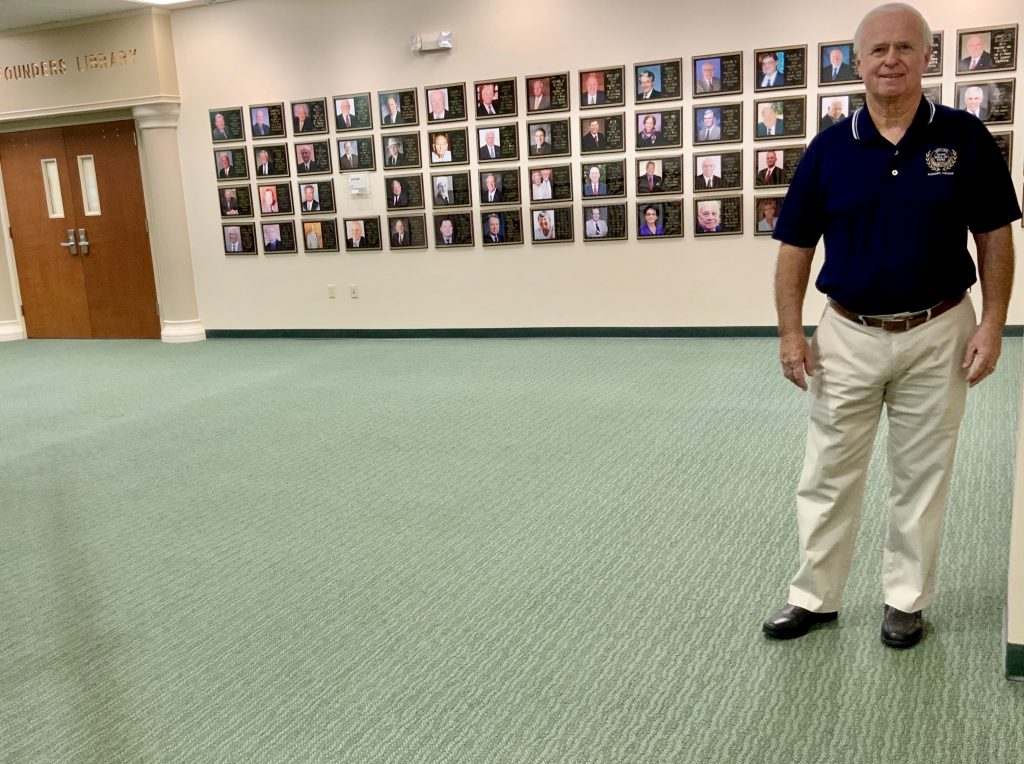
Executive leadership: Rex Cox (1972–1976); John Martin (1976–1977); Dr. Carlton Edwards (1977–1980); Herbert Reeves Jr. (1981–1983); Kenneth Rhoton (1983–1984); Gene Keener (1984); Vern Sailor (1985–1990); Mike Jones (1990–1993); Carl Ehry (1994–2011); Thomas McNulty (2011–2012); Darryl Searer (2012–2025); Daryll Milnikel (2025–present).
Board chairmen: Richard Robb (1972–1975); J. Brown Hardison (1975–1977); Herb Tieder (1977–1985); Vern Sailor (1985–1990); Jack Tuff (1990–1991); Warren Jones (1991–1992); Greg Stout (1997–1998); Guy Veni (1999–2000); Steve Purdy (2001–2002); Dick Aker (2003–2004); James McGee (2005–2006); Dave Altman (2006–2008); Lon Larson (2008–2009); Bill Garpow (2010–2012); Barry Cole (2012–2014); Darryl Searer (2015–2016); Joe Stegmayer (2017–2018); Mick Ferkey (2019–2021); Leo Poggione (2022–2023); Debbie Brunoforte (2023–2024); Joe Stegmayer (2025–present).
The RV/MH Heritage Foundation gratefully recognizes Hall of Fame member and industry historian George Allen, whose extensive research has helped preserve the people, events and milestones that shaped this institution. The Foundation also recognizes the foundational historical research of Hall of Fame member Dr. Carlton Edwards, along with the many industry leaders whose records, photographs and recollections contribute to the Foundation archives.
This page is an original Foundation summary informed by archival records, published Foundation materials and historical research; it does not reproduce the narrative text of those historians.