Caption: Interior view of the RV/MH Hall of Fame & Museum collection, featuring vintage campers and travel trailers on display.
Meta description: Explore the history of RVs through vintage travel trailers, antique trailers, pioneer profiles, and verified museum highlights at the RV/MH Hall of Fame & Museum in Elkhart, Indiana.
A modern RV can feel remarkably home-like: a comfortable bed, a well-equipped kitchen, climate control, and perhaps a television for evenings at the campground. Yet the earliest recreational vehicles offered a much humbler bargain. Travelers brought along folding beds, cooking equipment, and a generous tolerance for muddy roads.
The evolution from improvised camping rigs to today’s motorhomes and travel trailers is a fascinating chapter in American transportation, design, and leisure. At the RV/MH Hall of Fame & Museum in Elkhart, Indiana, that story unfolds through historic vehicles, photographs, memorabilia, and the people who helped make mobile living part of everyday culture.
To begin exploring the collection, visit the RV Founders Hall and the Museum Inventory. Those two official pages are the best starting points for a well-grounded walk through the collection.
The early history of RVs
The history of rvs began before the term “recreational vehicle” came into everyday use. Early travelers experimented with automobile camping, tent trailers, towable shelters, and motorized housecars. In plain English: people kept trying to bring more of home with them, then kept improving the wheels under it.
Authoritative overviews from the Smithsonian and the RV/MH Hall of Fame’s own interpretive material show that early development did not follow a single straight line. Motorized housecars and towable trailers developed side by side. That distinction matters in a museum setting. A travel trailer is designed to be towed behind another vehicle, while a housecar or lounge vehicle combines the living space with the powered vehicle itself.
By the 1910s and 1920s, inventors and travelers were already exploring the core ideas we now associate with RV design: sleeping space, built-in storage, weather protection, and the ability to move camp without starting from scratch each evening. By the late 1920s and 1930s, enclosed trailers, more efficient floor plans, and lightweight construction pushed the industry forward and gave shape to many of the forms visitors now recognize in vintage travel trailers and early motorhomes.
Three remarkable exhibits at the rv museum
The RV/MH Hall of Fame & Museum presents its collection chronologically, allowing visitors to see how materials, engineering, and travel habits changed over time. The official RV Founders Hall and Museum Inventory pages are especially useful for checking details before or after your visit. These three exhibits are especially strong anchors for understanding the early history of rvs.
1. The 1913 Earl Travel Trailer and Model T Ford
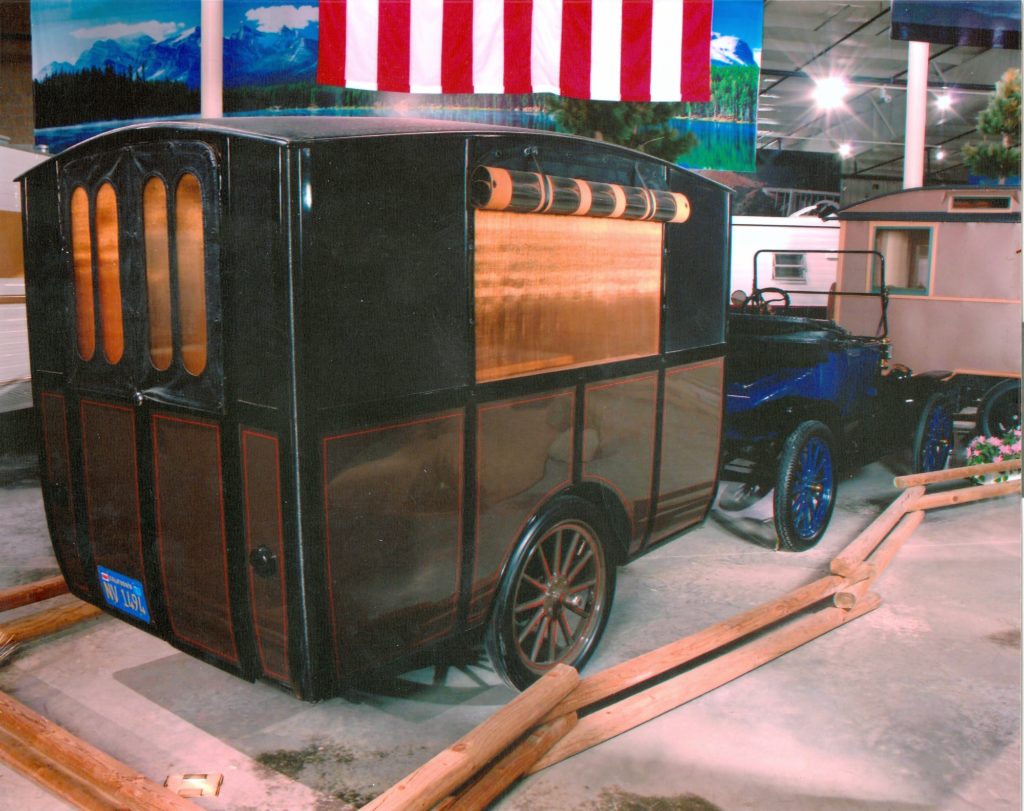
Caption: The 1913 Earl Travel Trailer and Model T Ford on display in the RV/MH Hall of Fame & Museum.
The museum’s official wording describes the 1913 Earl Travel Trailer and Model T Ford as “Believed to be the oldest non-tent travel trailer in existence. Custom built for a Cal Tech professor.” The Museum Inventory also notes that it is on permanent display courtesy of Wade Thompson, Thor Industries.
For anyone tracing the beginnings of vintage travel trailers, this exhibit is foundational. It shows that even in the 1910s, travelers were already experimenting with dedicated towable living space rather than relying only on tents and improvisation.
2. Mae West's 1931 Chevrolet Housecar
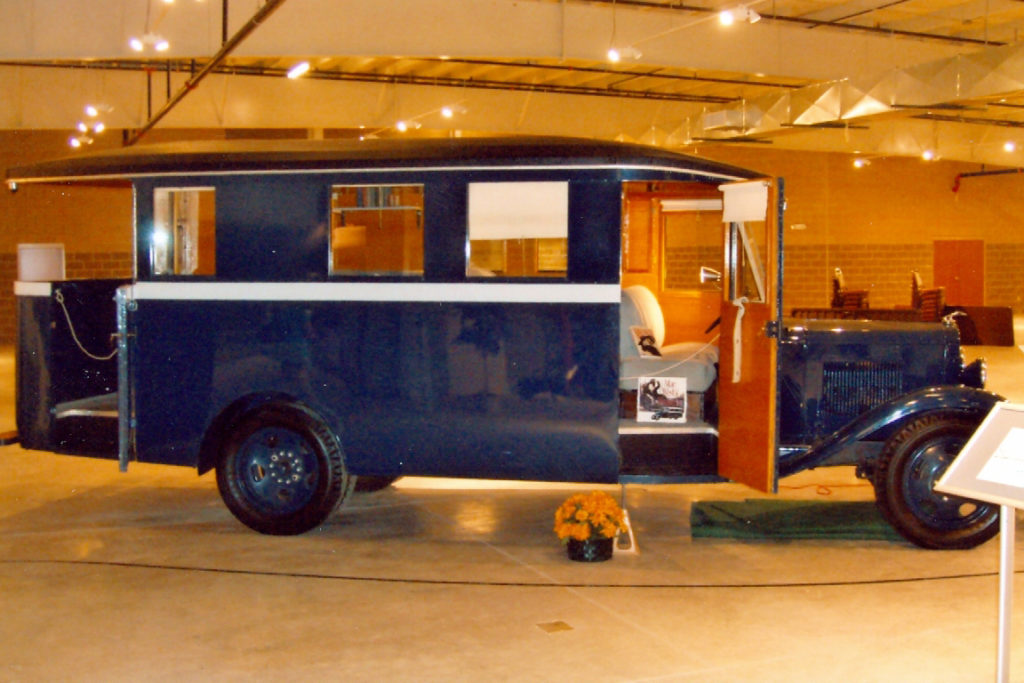
Caption: Mae West's 1931 Chevrolet Housecar, built for Paramount Studios, on display in the RV Founders Hall Museum.
The museum identifies Mae West’s 1931 Chevrolet Housecar as having been built for Paramount Studios to present to Mae West when she left vaudeville to make movies for the studio in 1931. Its official description adds an important clarification: “It is a chauffeur driven lounge car not a camper.”
That distinction matters. In the history of rvs, not every vehicle in the museum fits neatly into today’s categories, and that is part of the fun. This housecar broadens the story by showing how luxury, celebrity, and mobile design could overlap in the early years.
3. The 1935 Bowlus Road Chief Trailer
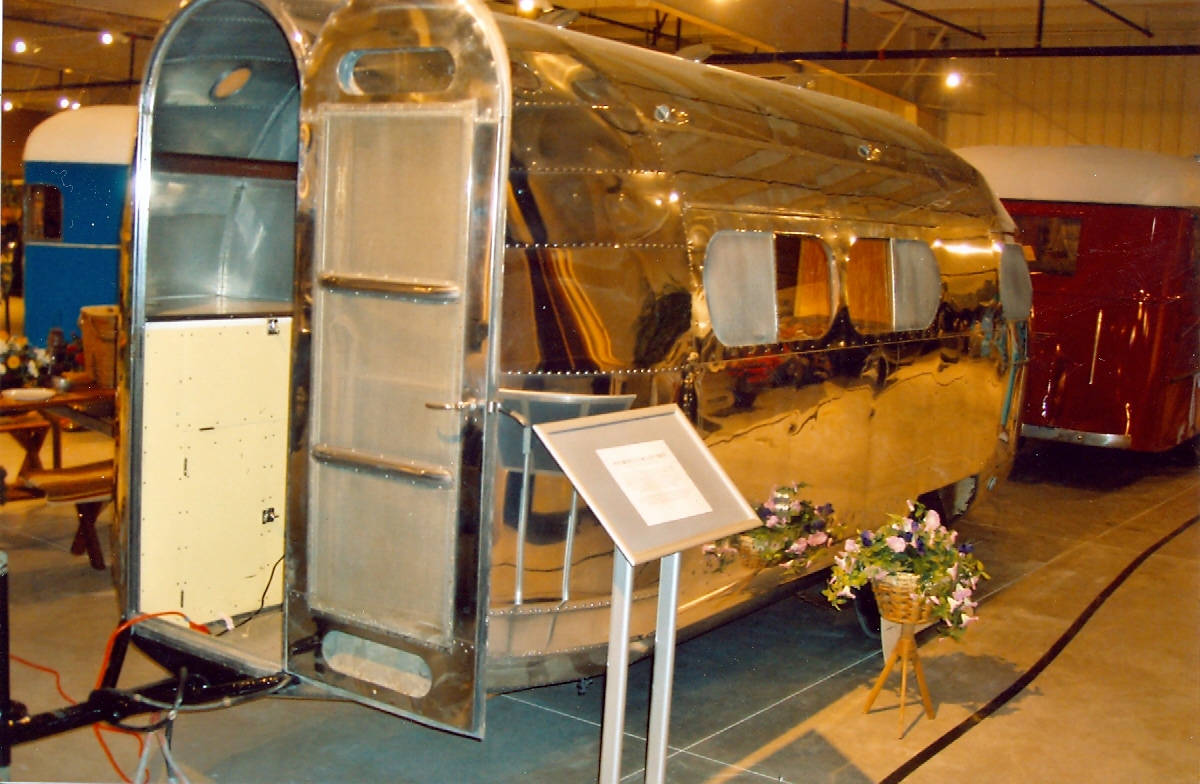
Caption: The 1935 Bowlus Road Chief Trailer, one of fewer than 50 known to survive, on display in the RV/MH Hall of Fame & Museum.
The museum describes the 1935 Bowlus Road Chief Trailer as “One of less than 50 Road Chiefs known to still exist. A predecessor to the better known Airstream Clipper. Built by Hawley Bowlus, a leading manufacturer and pilot of gliders. This was his personal camper.”
For visitors interested in antique trailers, the Bowlus is a splendid example of aerodynamic thinking entering trailer design. It also helps explain why certain streamlined forms became so influential in later vintage travel trailers: once you see the curve and riveted logic of the thing, the family resemblance is hard to miss.
More vintage travel trailers to discover
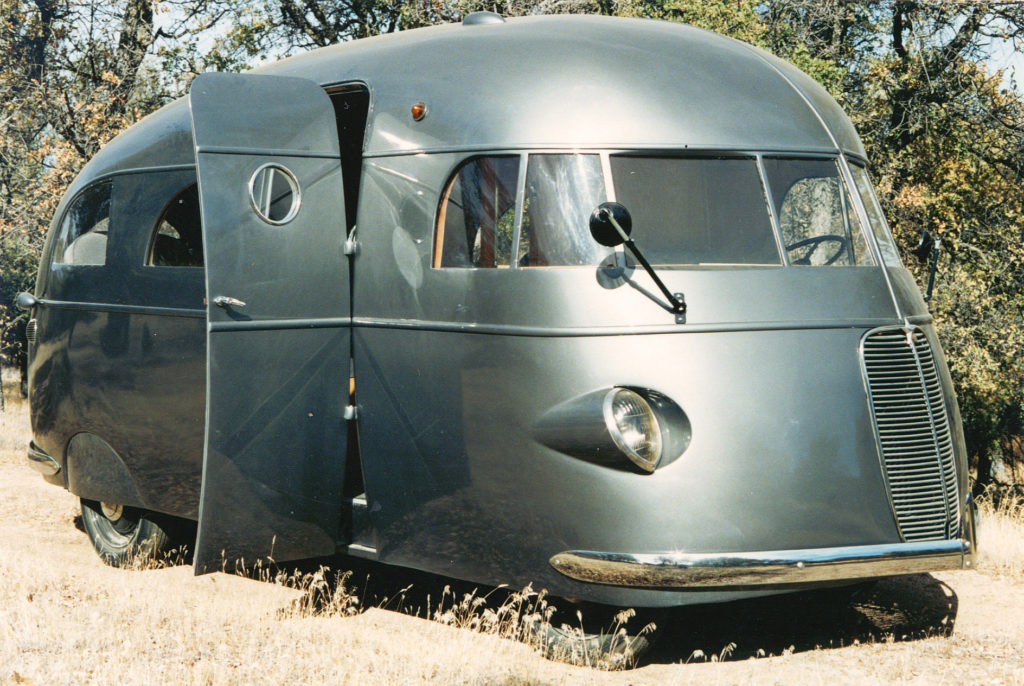
Caption: The 1937 Hunt Housecar, one of several early housecars built by Hollywood cinematographer Roy Hunt between 1935 and 1945.
The museum’s collection includes other notable vehicles that help round out the story, and the official inventory is the proper guide here. Depending on current display arrangements, readers may also encounter references to the 1937 Hunt Housecar, the 1935 Covered Wagon 17-foot travel trailer, the 1932 Gilkie Tent Trailer, the 1954 Ranger pop-up by Hille Engineering, and the 1985 Fleetwood Bounder prototype developed by Fleetwood founder John Crean for the 1986–87 Bounder.
For exhibit-by-exhibit confirmation, use the RV Founders Hall and Museum Inventory pages before citing a model year, builder, or feature in print.
The David Woodworth Collection
The Foundation also interprets important early vehicles through the David Woodworth Collection. The Foundation acquired historian David Woodworth’s collection of antique recreational vehicles and historical materials, made possible through major support from Hall of Fame member Robert “Boots” Ingram and his wife, Betty.
Vehicles associated with that interpretation include the 1916 Ford Telescoping Apartment, 1916 Cozy Camp Tent Trailer, 1928 Pierce Arrow Fleet Housecar, 1929 Wiedman Housecar, 1931 Chevrolet Housecar, 1931 Ford Model AA Housecar, 1936 Roadhome Coach, and 1937 Hunt Housecar. Preserved original vehicles like these allow visitors to encounter the experimental years of recreational travel firsthand rather than through photographs alone, which is a much more satisfying arrangement for everybody except perhaps the dust jackets.
Where this article names a specific artifact, the aim is to stay close to museum interpretation or other authoritative source language. For a broader scan of the collection, use the RV Founders Hall page for featured exhibits and the Museum Inventory page for a wider look at what is on display.
Pioneers who shaped RV design and culture
Vehicles tell only part of the story. The history of rvs also belongs to designers and manufacturers whose work appears in the Museum Inventory, the RV Founders Hall page, and Hall of Fame records.
Wally Byam
Wally Byam is associated with Airstream, one of the most recognizable names in streamlined trailer design. In the context of this rv museum, his name helps visitors connect the rise of aluminum-bodied vintage travel trailers to the broader design movement of the 1930s and beyond.
Hawley Bowlus
Hawley Bowlus is directly tied to the 1935 Bowlus Road Chief Trailer in the collection. The museum notes that he was a leading manufacturer and pilot of gliders, and that the displayed Road Chief was his personal camper.
John Crean
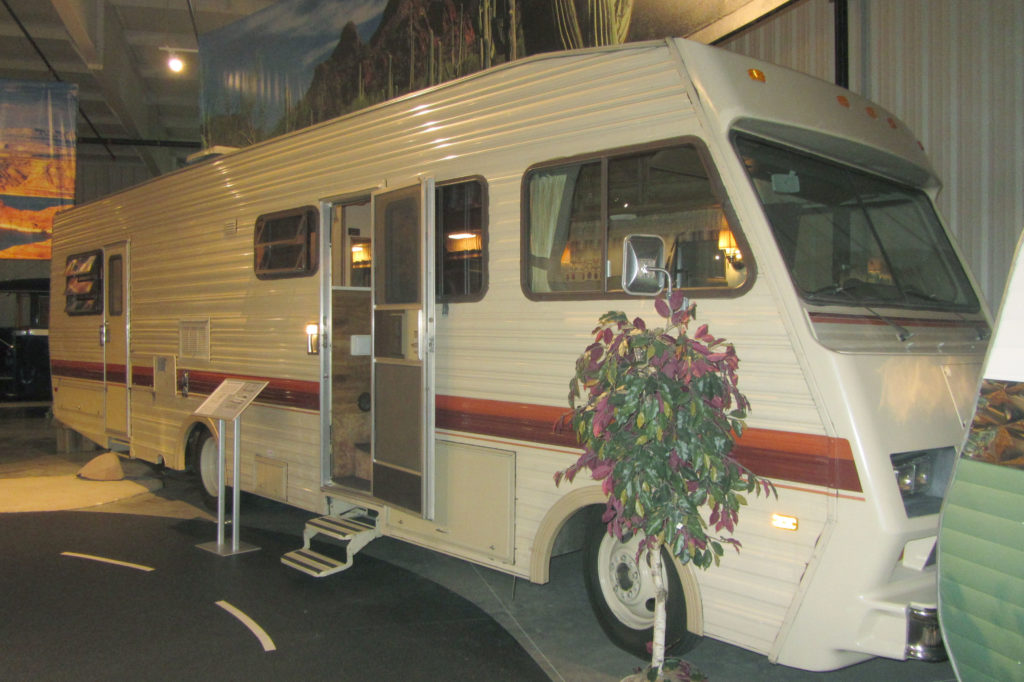
Caption: Fleetwood founder John Crean's 1985 prototype for the 1986-87 Bounder, on display in the RV Founders Hall Museum.
John Crean is linked in museum interpretation to Fleetwood and the 1985 prototype for the 1986–87 Bounder. That vehicle helps illustrate how later RV development moved from one-off experimentation toward mass-market motorhome innovation.
Richard Klingler
Richard Klingler is documented in Hall of Fame records with Holiday Rambler. His place in the gallery of pioneers helps visitors understand how major brands shaped the later chapters of the history of rvs represented in the museum.
Lloyd Bontrager
Lloyd Bontrager is associated with Jayco in Hall of Fame records. His inclusion helps connect the museum’s early antique trailers to the family-oriented towable market that would become a major part of the industry.
Elmer Weaver
Elmer Weaver is tied to Yellowstone in Hall of Fame documentation. He represents one of the brand-builders who helped expand the practical appeal of RV travel to a wider public.
Thomas Corson
Thomas Corson is associated with Coachmen in the Hall of Fame record. His profile fits the museum’s larger story of companies that carried recreational vehicle design from early experiments into established production.
John K. Hanson
John K. Hanson is identified with Winnebago in Hall of Fame materials. In a museum setting, his name helps frame the growth of motorhome manufacturing as the industry matured.
Eugene Vesely
Eugene Vesely is tied to Apache, a name especially relevant to folding camping units and pop-up history. That connection pairs naturally with the museum’s interpretation of vehicles such as the 1954 Ranger pop-up by Hille Engineering, which show how compact camping design evolved.
Franklin A. Newcomer
Franklin A. Newcomer is associated with FAN in Hall of Fame records. He belongs in this article as part of the documented network of manufacturers whose work broadened the industry’s reach and technical variety.
Ray Frank
Ray Frank is linked to Travco in Hall of Fame materials. His association helps bridge the museum’s early housecars and trailers with the later motorhome era represented elsewhere in the collection.
John Serro
John Serro is documented with Serro Scotty. His place among the pioneers underscores how compact, recognizable towables became part of the enduring appeal of vintage travel trailers.
Clyde Grambsch
Clyde Grambsch is associated with E-Z Kamper in Hall of Fame records. His profile adds another chapter to the museum’s broader story of inventive camping solutions and lighter recreational units.
Kelly Rose
Kelly Rose is tied to Starcraft in Hall of Fame documentation. His inclusion helps visitors connect the museum’s early and mid-century towables to one of the longstanding names in recreational manufacturing.
Virgil Miller
Virgil Miller is associated with Newmar in Hall of Fame records. He represents the continued development of motorized RV design after the formative decades highlighted by the museum’s earliest vehicles.
Clarence Yoder
Clarence Yoder is documented with Carriage in Hall of Fame materials. His profile rounds out the pioneer list by showing how the industry continued to diversify long after the first antique trailers and housecars took to the road.
If you would like to go deeper on individual Hall of Fame inductees, start with the official member pages on thervmhhalloffame.org and then supplement with additional Foundation resources where appropriate.
Plan your museum visit
The RV/MH Hall of Fame & Museum is a rewarding stop for RV enthusiasts, families, design students, history buffs, and anyone curious about how Americans have traveled and lived on the move. Allow two to three hours for a comfortable campus visit so you can study the vehicles and compare changing approaches to construction, storage, sleeping, cooking, and transportation. If you enjoy vintage travel trailers, the broader history of rvs, or the craftsmanship of antique trailers, this rv museum offers plenty to examine at a close, unhurried pace.
The museum is located at 5600 Executive Parkway, Elkhart, IN 46514, making it a natural addition to a Northern Indiana trip focused on RV manufacturing, local history, and nearby attractions.
Summer hours are April 1-October 31, Monday-Saturday 9:00 AM-5:00 PM ET and Sunday 10:00 AM-3:00 PM ET.
Winter hours are November 1-March 31, Monday-Tuesday 10:00 AM-4:00 PM ET, Wednesday closed, Thursday-Saturday 10:00 AM-4:00 PM ET, and Sunday 10:00 AM-3:00 PM ET.
The museum is closed on Thanksgiving, Christmas Day, and New Year’s Day.
Admission is Adults $20.56, Seniors 60+ $15.89, Children ages 6-16 $12.15, Children 5 and under free, and Groups of 14+ $15.89 per person.
Museum guests may also use the property for overnight stays under the current visitor guidelines. Complimentary boondocking is available with at least one paid museum admission per RV and is limited to two consecutive nights. Electric hookups are $40 per night. All stays require staff confirmation, and readers should always check the website for blackout dates before arriving.
For groups, conventions, celebrations, and other gatherings, the Northern Indiana Event Center offers flexible spaces for events ranging from small meetings to large conventions. In-house AV support is limited for rental clients, so event planners should work with preferred outside vendors such as EA Pro Music. Learn more through the Northern Indiana Event Center event-planning page.
Navigation tip: if your goal is exhibits, begin with the RV Founders Hall, the Museum Inventory, and the Plan Your Visit page. If your goal is hosting an event, turn next to the Northern Indiana Event Center event-planning page. A good museum visit, after all, should not begin with avoidable wandering.
Keep the journey going
The story of RVs is ultimately a story of problem-solving. Travelers wanted to go farther, stay longer, and remain comfortable while doing it. Designers answered with folding rooms, solid walls, streamlined bodies, clever storage, improved utilities, and, occasionally, with enough flair to make a museum visitor stop and grin.
At the RV/MH Hall of Fame & Museum, these innovations remain tangible. The antique trailers, housecars, and historic motorhomes invite visitors to look closely, ask questions, and consider how yesterday’s experiments became today’s road-going homes.
If you would like to see the history of rvs in person, plan a visit to the RV/MH Hall of Fame & Museum, explore the RV Founders Hall, review the Museum Inventory, and make time to experience this rv museum for yourself.
Sources and further reading
- RV/MH Hall of Fame & Museum: RV Founders Hall
- RV/MH Hall of Fame & Museum: Museum Inventory
- RV/MH Hall of Fame & Museum: Plan Your Visit / FAQs
- RV/MH Heritage Foundation: Museum Photo Gallery
- Smithsonian Magazine: “A Brief History of the RV”
- Airstream History & Heritage
- Airstream: “Make history”: Wally Byam, design pioneer
- Bowlus: Our Story